Vulnerability intelligence · AI agent · MCP
Vulnerability Exposure Analyzer
An AI agent that checks IP addresses, domains, CVEs and software versions for confirmed vulnerabilities and exposure across public threat-intelligence sources, then writes an evidence-based security assessment. By default, Cohere's Command A+ model decides which tools to run (Command A and Command A Reasoning can also be chosen), every finding is tied back to the source that produced it, and code checks the report against the data. The same checks are available as an MCP server for Claude, Cursor and VS Code.
- Python
- Streamlit
- Cohere Command A+
- MCP
- NVD
- CISA KEV
- FIRST EPSS
- OSV.dev
- Shodan
- VirusTotal
- AbuseIPDB
Screenshots
1 / 8
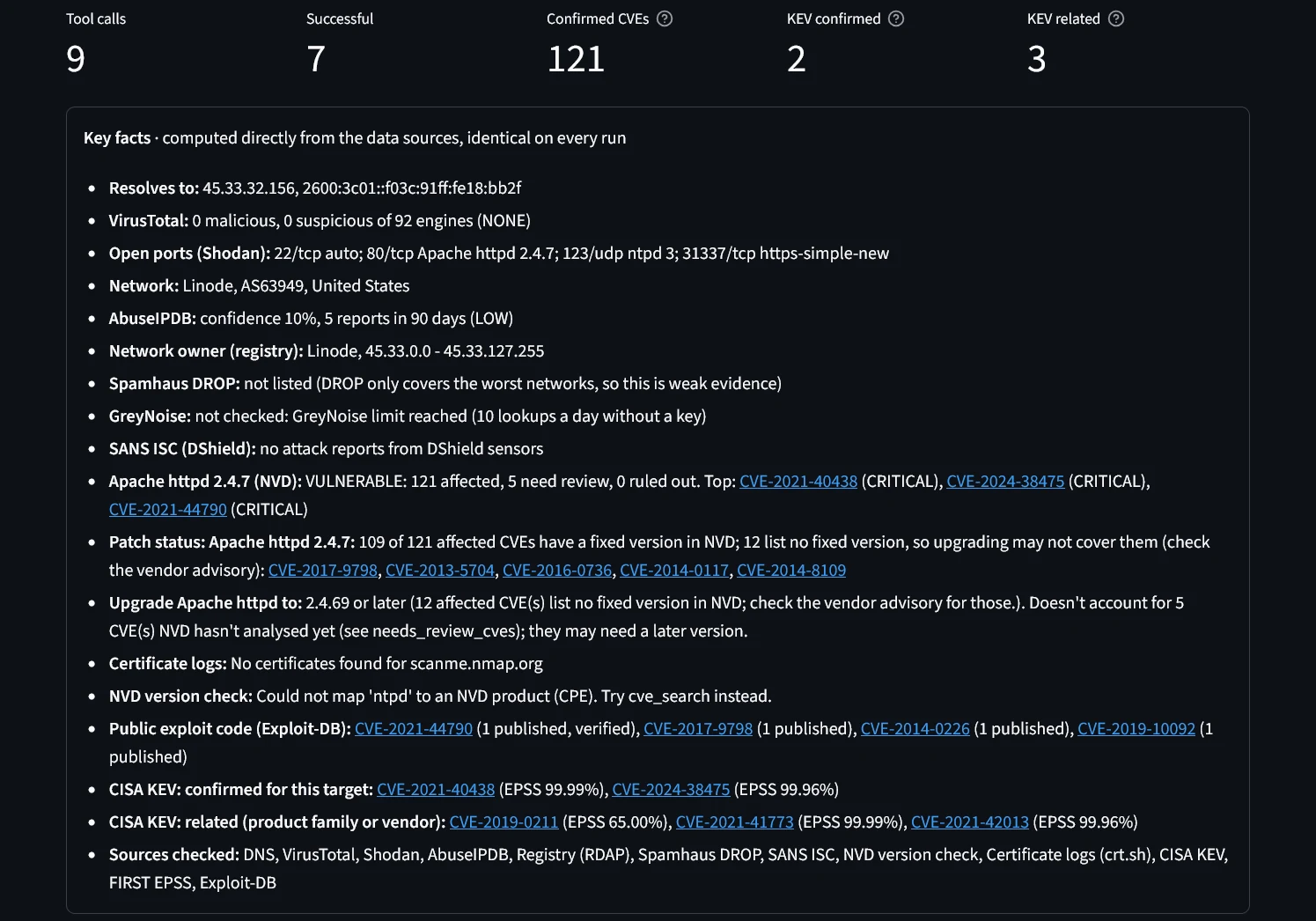
Key facts from the data
A Standard Analysis of scanme.nmap.org. The Key facts are built in code from the data sources, so they're identical on every run: DNS, VirusTotal, Shodan's open ports, AbuseIPDB, the network owner, threat lists, the 121 CVEs NVD confirms for Apache httpd 2.4.7, published exploits and CISA KEV matches.
2 / 8
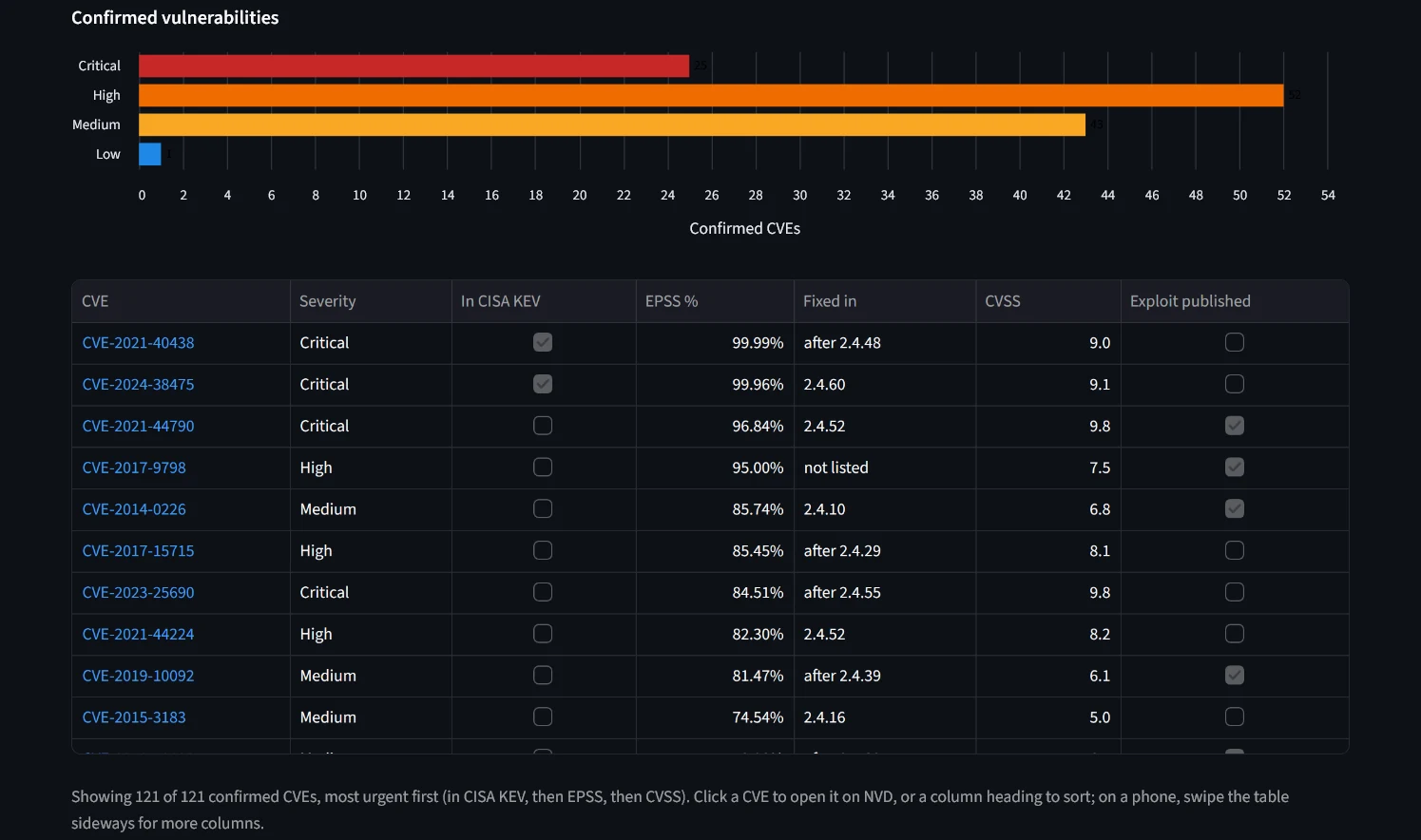
Every confirmed CVE, most urgent first
A severity chart and a sortable table of all 121 confirmed CVEs, ordered by CISA KEV, then EPSS, then CVSS, with each one's fix version and whether exploit code is published. Each CVE links to its NVD page.
3 / 8
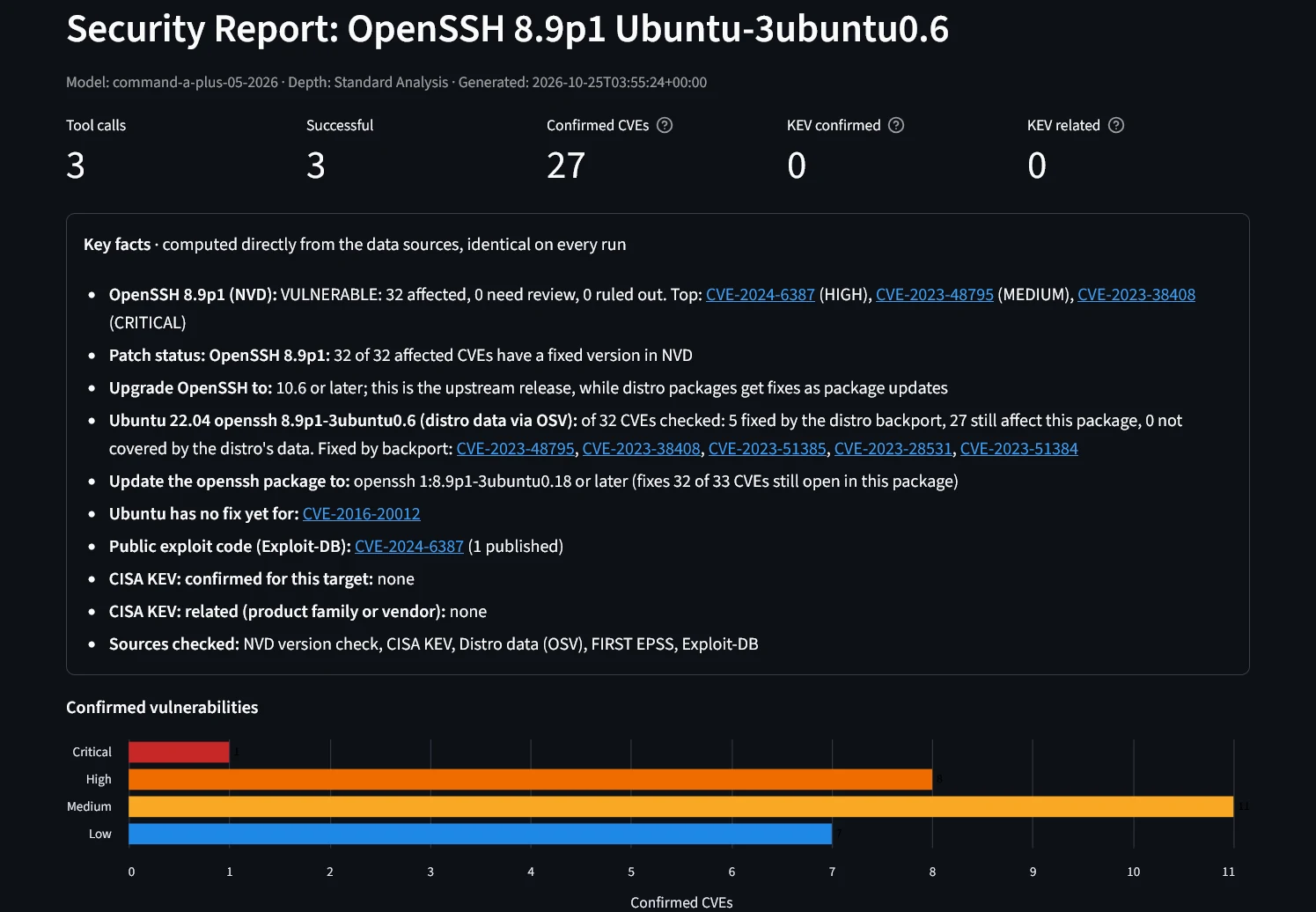
Distro backports count
For OpenSSH 8.9p1 Ubuntu-3ubuntu0.6, NVD matches 32 CVEs, but Ubuntu's own data (via OSV.dev) shows 5 already fixed in that package, so 27 remain, and the chart counts only those. It also names the Ubuntu package version that fixes the rest.
4 / 8
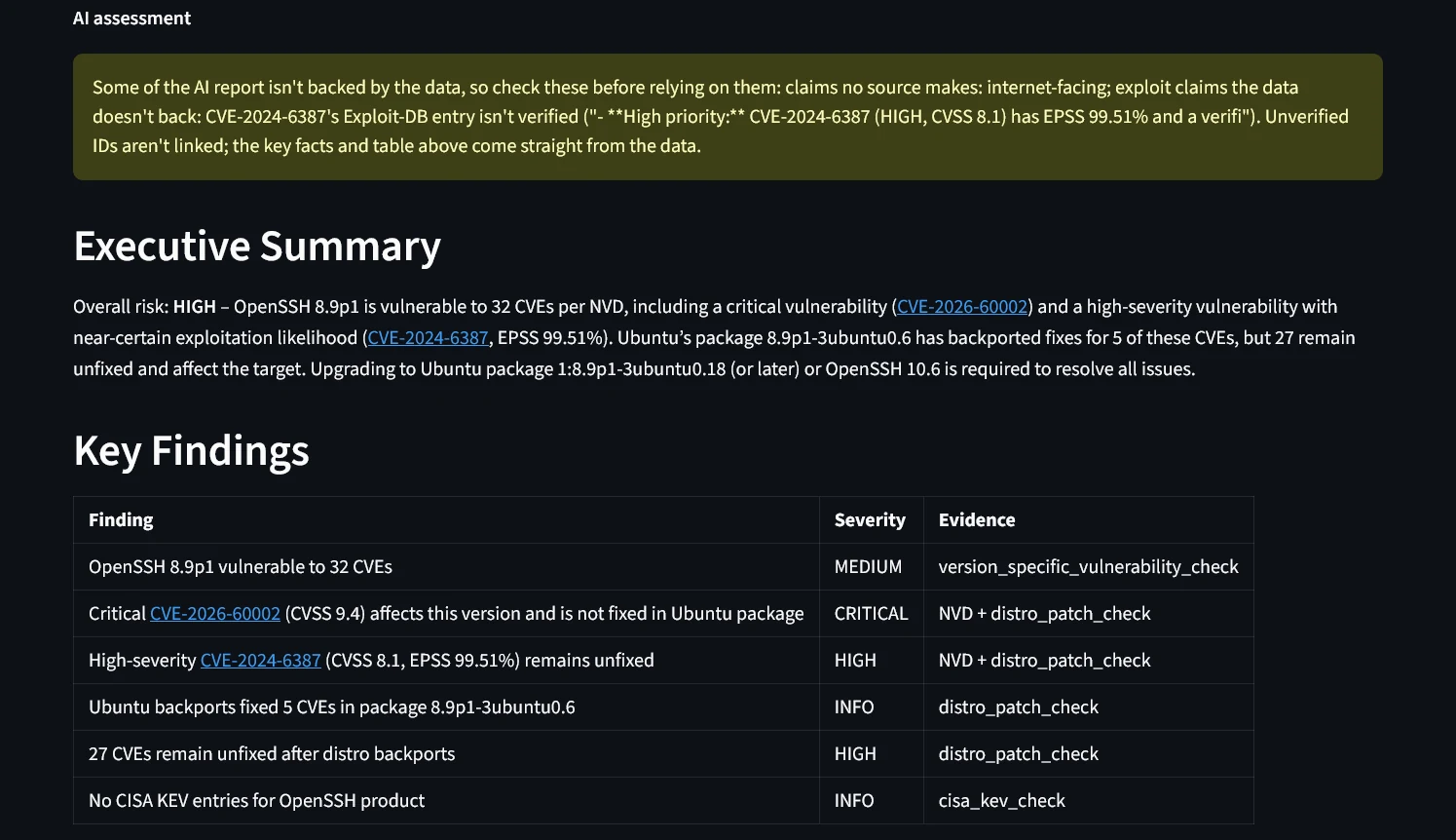
The report is checked against the data
Code compares the AI's report with the tool results and flags anything they don't support. Here it caught an exploit described as verified that Exploit-DB lists as unverified, and an internet-exposure claim no source made.
5 / 8
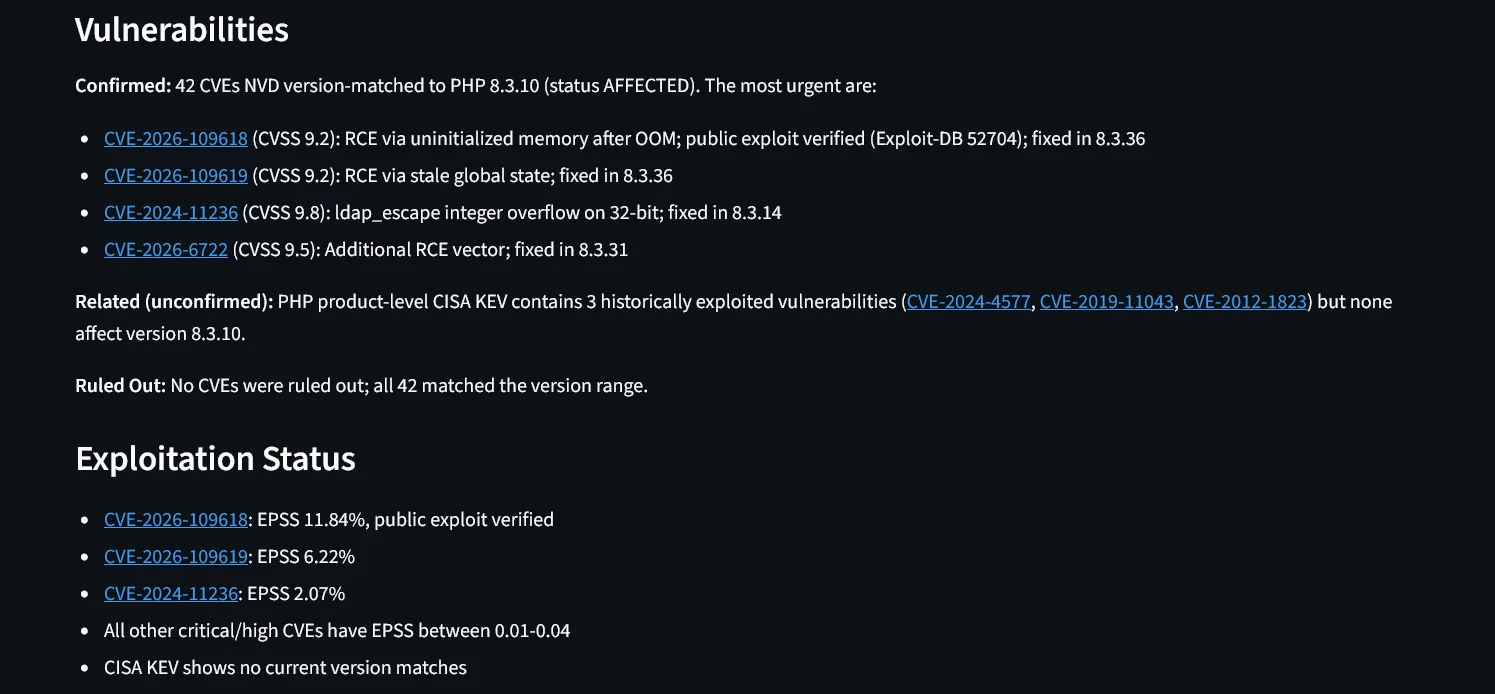
Confirmed, related and ruled out
For PHP 8.3.10: the 42 CVEs NVD confirms for this exact version, PHP's older CISA KEV entries listed as related rather than confirmed, and EPSS and published exploits for the most urgent ones.
6 / 8
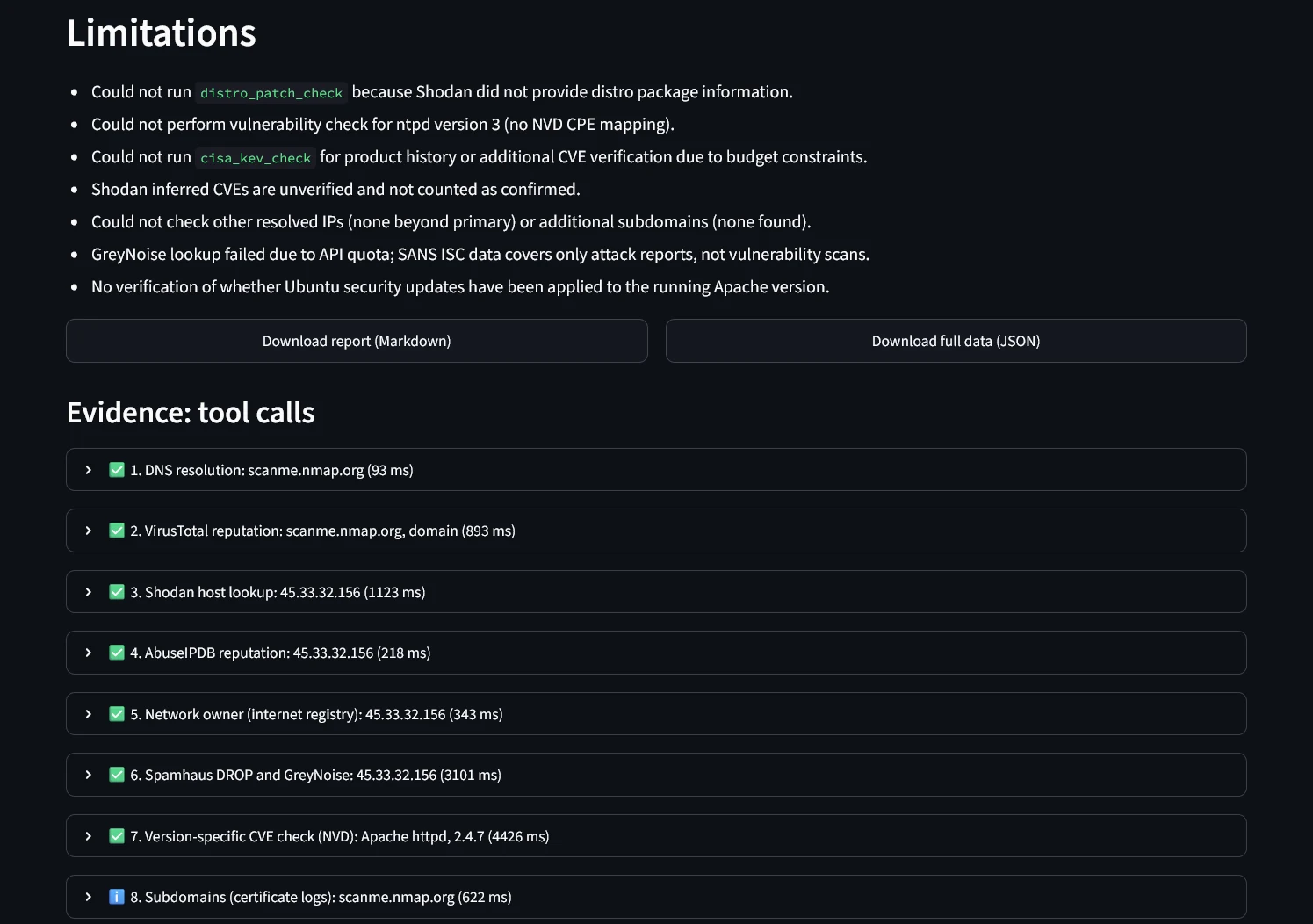
Limitations and evidence
The report's own limitations, Markdown and JSON exports, and every tool call behind it with its timing.
7 / 8
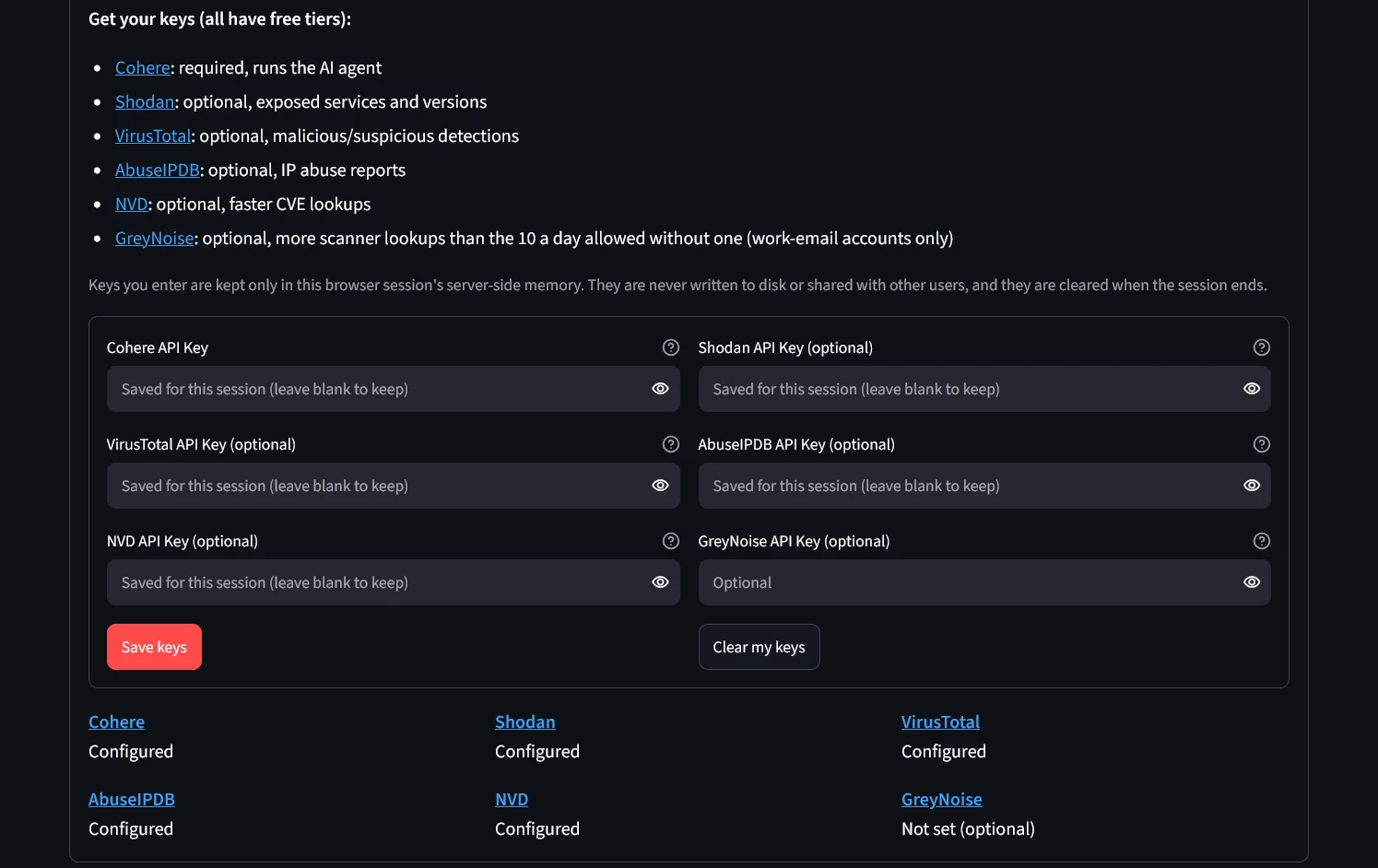
API keys stay in your session
Keys entered in the app are kept only in that browser session's server memory. They're never written to disk or shared with other visitors, and the page only ever shows them as Configured.
8 / 8
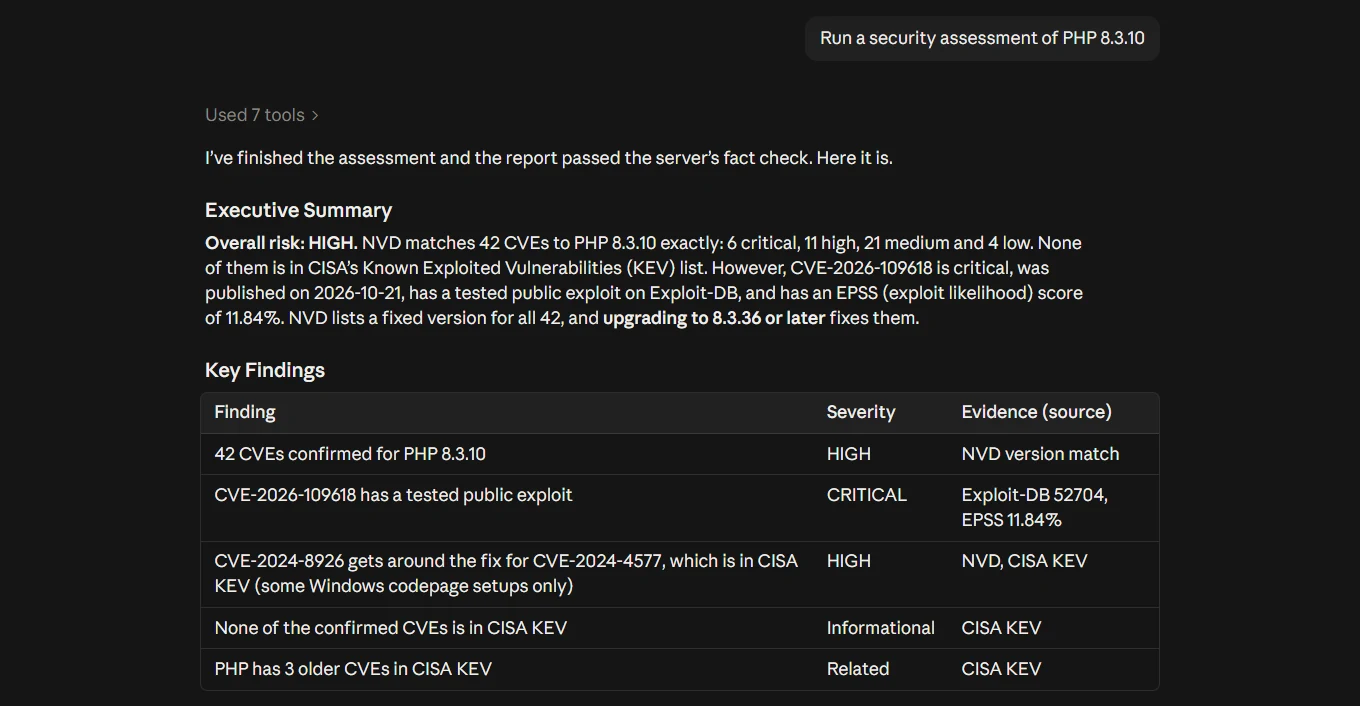
Also an MCP server
The same checks as an MCP server, here in Claude: 7 tool calls for PHP 8.3.10, and a report that passed the server's check_report before Claude answered. No Cohere key is needed, since the client's own model writes the report.
Screenshots from local runs against scanme.nmap.org (a server the Nmap project provides for testing security tools), PHP 8.3.10 and OpenSSH 8.9p1 Ubuntu-3ubuntu0.6, and of the MCP server in Claude. Click a screenshot to open it full size. Use the arrows, or select the gallery and press ← →.
How it works
- Classify the input as an IP, domain, CVE, software version or distro package build (such as
OpenSSH 8.9p1 Ubuntu-3ubuntu0.6), rejecting anything invalid or non-public. - Baseline lookups in code: for IPs and domains, DNS, Shodan (or its free InternetDB), VirusTotal, AbuseIPDB, the network owner, Spamhaus DROP, GreyNoise and SANS ISC run before the AI starts, so core coverage never depends on the model.
- Investigate: the agent chooses further tools (NVD version check, Ubuntu and Debian patch check, NVD lookup, CISA KEV, keyword search, subdomains) within a per-run budget. Duplicate calls are served from cache.
- Verify versions: a CVE counts as confirmed only when NVD's affected-version ranges include the exact version, re-checked locally. GitHub and PyPA advisories via OSV.dev cover packages NVD hasn't analysed yet, and for Ubuntu and Debian packages the distro's own data overrides NVD for CVEs it has already fixed.
- Report: code builds the Key facts, the severity chart and the CVE table. The model writes the summary, findings, details (Confirmed, Related, Needs Review, Ruled Out), recommendations and limitations, citing a source for every claim.
- Check: code compares the report with the data and warns about anything it doesn't support: CVE IDs no lookup returned (looked up in NVD to tell a real one from a made-up one), misquoted fix versions, unconfirmed or distro-fixed CVEs filed as confirmed, and exploit claims the data doesn't back.
Security decisions
- Per-session API keys. Keys come only from what each visitor types into the app. They stay in that browser session's server memory, never reach environment variables or disk, and are never shared between visitors.
- Safe rendering. Reports contain third-party text such as service banners, so raw HTML is never rendered and remaining
[,]and<are escaped. The only links are ones code builds from CVE IDs to NVD; URLs from third-party data are shown as plain text, and remote images that could leak a viewer's IP can't survive. - Prompt-injection hardening. Tool output reaches the model as data documents, with instruction-like text in banners, hostnames and registry records removed first. Results are size-capped, and the model can't change server-side limits or look up an IP the evidence never mentioned.
- Safe outbound requests. Lookups use HTTPS only, follow redirects by hand and refuse any that lead to private addresses, drop API keys when a redirect changes host, and cap response size.
- Input validation. Private, loopback, link-local and CGNAT addresses are rejected, and CVE IDs, domains and IPs are validated before any API call.
- No leaks in logs. Error messages are scrubbed of API key values, stack traces are hidden from visitors, usage stats are off, and analyzed targets aren't written to server logs.
- Facts separate from AI text. The Key facts, chart and CVE table come straight from the data, and the report check marks anything in the AI's text that the data doesn't support.